
Ypsomed – Planning and Implementation of the Ideal Factory
With global demand for its self‑treatment solutions steadily increasing, Ypsomed commissioned IE Plast to plan and implement an ideal greenfield factory in Schwerin, designed for scalable future growth.

Growth Scenarios Planned from the Start
Project
Planning and implementation of the ideal factory for Ypsomed.
Client
Ypsomed AG
Key Data


Working Together for Project Success
Services provided by IE Group
- Masterplan
- General Planning
- Overall responsibility as general contractor
- With industry‑specific expertise for the ideal factory concept
- Cleanroom design, GMP compliance
- Intralogistics and material flow planning
Scalable design enabling future capacity doubling

Challenges & Solutions
All growth options considered from the outset
Forward-looking construction approach
Planning certainty through partnership
Consistently flexible infrastructure
Efficient cleanroom sizing
The Project in Detail
Production hall of the future – The Challenge
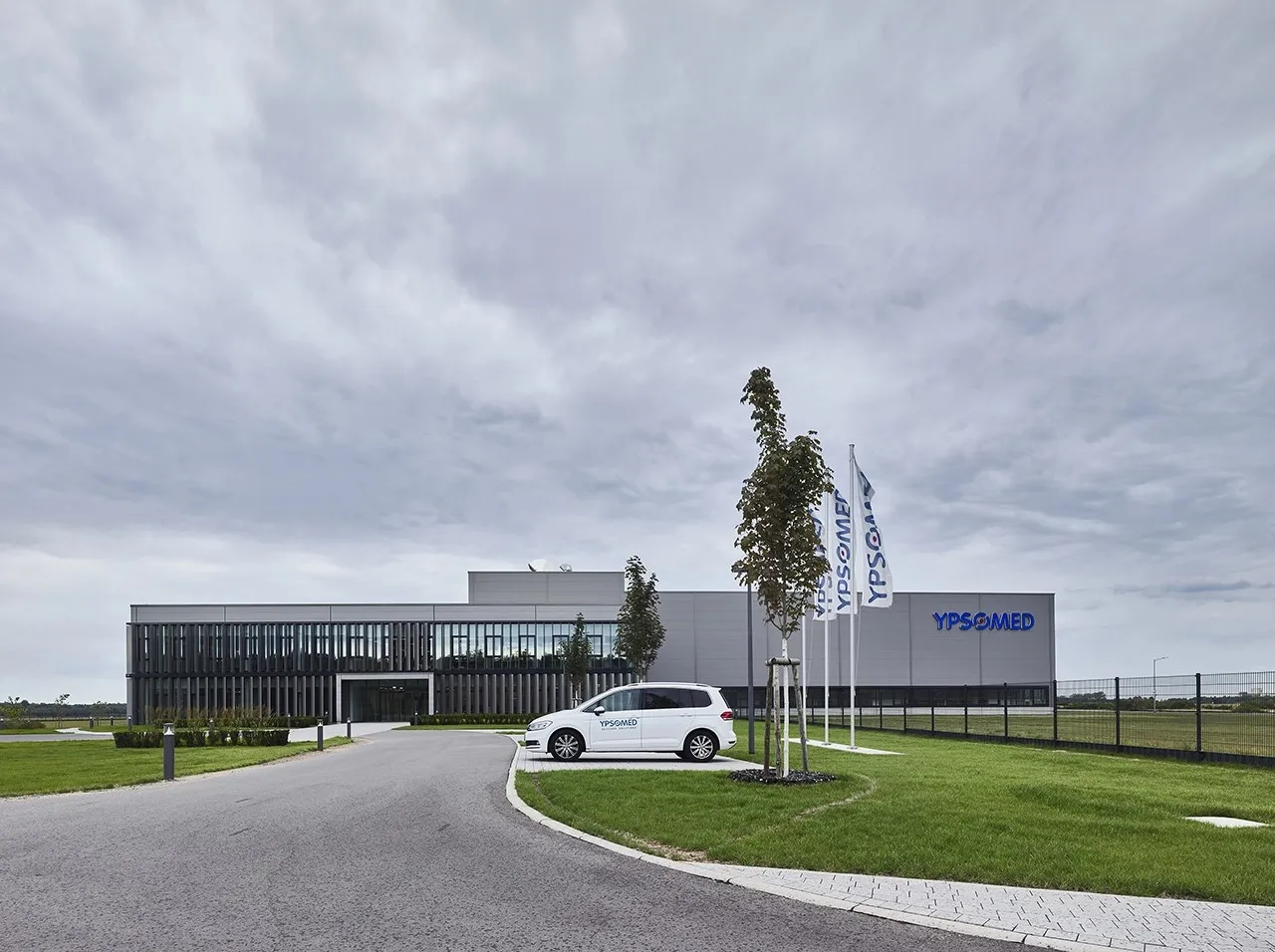
Driven by sustained dynamic growth, Ypsomed continuously expanded its production capacities in Switzerland in recent years. Once the expansion potential at its Swiss sites had been fully utilized, the company began searching for a suitable international location for the production of injection pens and insulin pumps. The decision was made in favor of Schwerin, offering excellent conditions for industrial production and sufficient available land. This provided the ideal foundation for Ypsomed’s long‑term growth strategy.
The ideal factory with cleanroom integration – Key Success Factors
1. A site designed for doubled production capacity
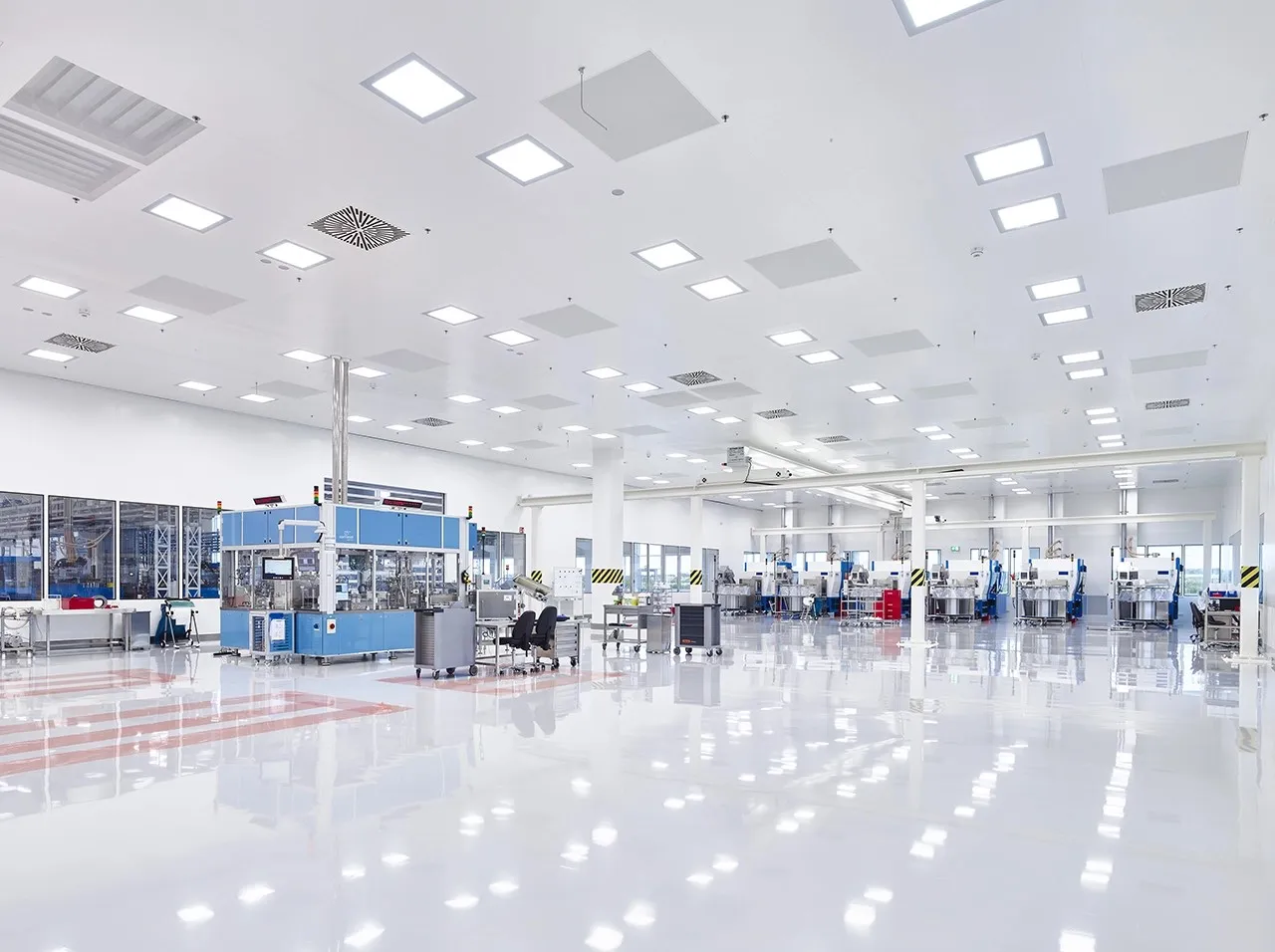
The new production facility was designed not only to meet current production requirements but also to anticipate future demand. In the first phase, 60 injection molding machines were installed, with an additional 30 planned for the second expansion phase. The ambition to double production capacity at the same site within a foreseeable timeframe posed a significant planning challenge. Cleanroom capacities, material logistics, media supply, assembly and packaging lines, as well as storage capacities all needed to scale accordingly. Ypsomed therefore entrusted IE Plast with Planning and Execution as general contractor. Decisive factors included IE’s industry expertise, the inside‑out planning approach, cleanroom know‑how, the one‑stop‑shop principle and binding guarantees for quality, schedules, functionality and costs. The collaboration began with the joint development of a masterplan based directly on IE’s ideal factory model.
2. The ideal factory model for automated processes
The ideal factory sets high standards for process efficiency, cleanliness, production safety, economic viability and scalability. A central backbone connects production, processing, supply and storage areas throughout the facility. Material, personnel and media flows are arranged vertically above one another and strictly separated. This enables a high degree of automation and allows production to be expanded during ongoing operations without adapting the zoning concept. Media systems are treated as flexible, movable elements rather than fixed components of the building. Supply is routed from top to bottom and can be adapted at any time to changing production layouts.
3. Scaling production through cleanroom‑integrated logistics
To develop a suitable zoning concept for the production of injection and infusion systems, IE Plast drew on its extensive experience in regulated GMP environments and its specialized cleanroom expertise. The result was a solution that minimizes the size of the critical cleanroom areas associated with high investment costs. To ensure efficient operation while maintaining GMP compliance, the zoning concept extends across the entire production facility, including all required transitions and airlocks.
4. Operational planning with future challenges in mind
The greenfield development of the Ypsomed production facility gave planners and client the freedom to implement the ideal factory concept without restrictive boundary conditions. From the outset, all future development steps defined in the masterplan were taken into account. The first phase comprised approximately 24,000 m² of gross floor area, including backbone, production halls, assembly, packaging, warehouse and raw material supply. Production was divided across three halls, with one hall serving as a reserve. This reserve can be brought into operation at short notice and equipped with an additional cleanroom if required.

Deepen Your Knowledge
Discover further details in our Project Insight.