Make Early Decisions. Integrate Correctly.
Make Early Decisions. Integrate Correctly.
When Material Supply Becomes a Planning Discipline
Companies in the plastics and technology industries are regularly confronted with the same fundamental question when planning new builds, conversions, or expansion projects: How can a production facility be designed to meet today’s requirements while at the same time offering sufficient flexibility for future developments? Production capacities are growing, sites are being consolidated, existing buildings are reaching their functional limits or simply the end of their lifecycle. At the same time, requirements regarding flexibility, traceability, energy efficiency, and process stability continue to increase.
Companies in the plastics and technology industries are regularly confronted with the same fundamental question when planning new builds, conversions, or expansion projects: How can a production facility be designed to meet today’s requirements while at the same time offering sufficient flexibility for future developments? Production capacities are growing, sites are being consolidated, existing buildings are reaching their functional limits or simply the end of their lifecycle. At the same time, requirements regarding flexibility, traceability, energy efficiency, and process stability continue to increase.
Factory Planning Between Production, Technology, and Building Design
The planning of modern industrial buildings can no longer be reduced to the mere provision of space. Production layout, material flows, utilities supply, hygiene zones, and technical infrastructure form a tightly interconnected system. Changes in one area inevitably affect others. If these interdependencies are not taken into account during early planning phases, conflicting objectives arise that can only be resolved later with considerable effort.
Especially in plastics processing operations, technical systems such as material conveying, drying, or dedusting cannot be treated as downstream equipment. They shape the building structure, influence machine arrangement, define utility routes, and affect structural design, maintenance concepts, and future expandability. An integrated planning approach, in which production processes, plant technology, and building structure are developed in parallel, creates the necessary transparency and planning reliability.
Focus on Energy Supply – Material Supply as an Equal Factor
In almost every refurbishment and construction project in the plastics processing industry, early attention is focused on energy supply. Demand-oriented electrical grids, cooling of process heat, heat recovery systems, energy storage, combined heat and power plants, or the integration of external energy sources such as variable electricity tariffs or participation in energy parks are now well-established topics. Modern control and automation concepts allow for the efficient combination of various internal and external energy sources. As important as these aspects are, it must not be overlooked that without a functioning material supply, no manufacturing process can take place. While energy supply is often centrally planned, material supply in many companies has evolved historically and remains decentralized. Particularly in thermoplastics processing, increasing numbers of machines and material variants lead to growing complexity, inefficiency, and lack of transparency.
Material Supply in Plastics Processing – From Individual Workstations to a Structural Issue
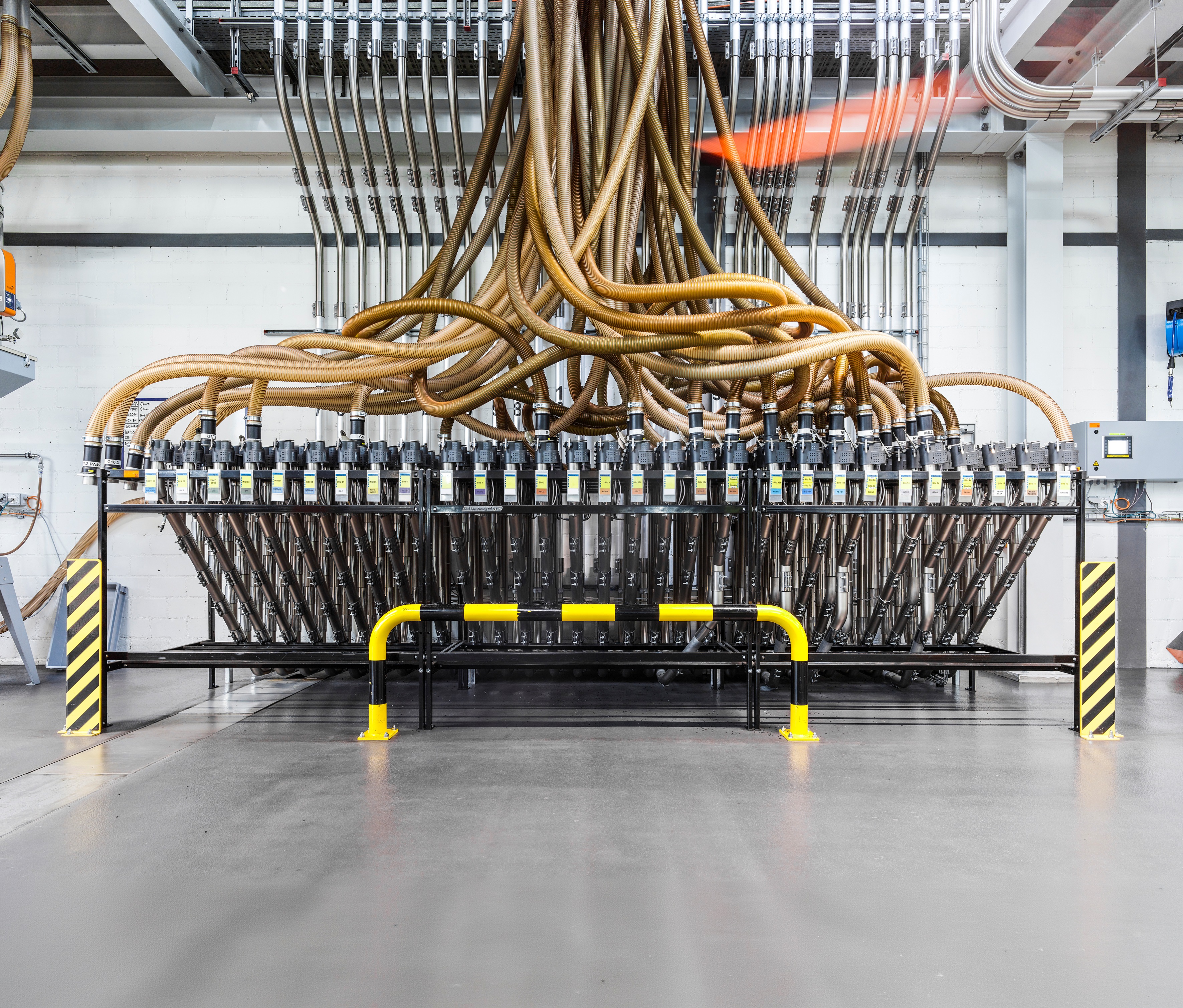
In traditional plant concepts, processing machines are often supplied with material individually. Vacuum conveying systems from different manufacturers feed individual machines, each configured for a specific application. While this approach remains manageable in small-scale operations, it rapidly loses efficiency as production size increases.
As the number of machines grows, manual interventions, transport distances, and organizational effort increase. Valuable production space becomes increasingly occupied. At the same time, the risk of material mix-ups, unclear material preparation states, hygiene weaknesses, and inefficient space utilization rises. Material supply thus evolves from a supporting process into a limiting factor of production.
Central Raw Material Conveying Systems as a Technical Solution
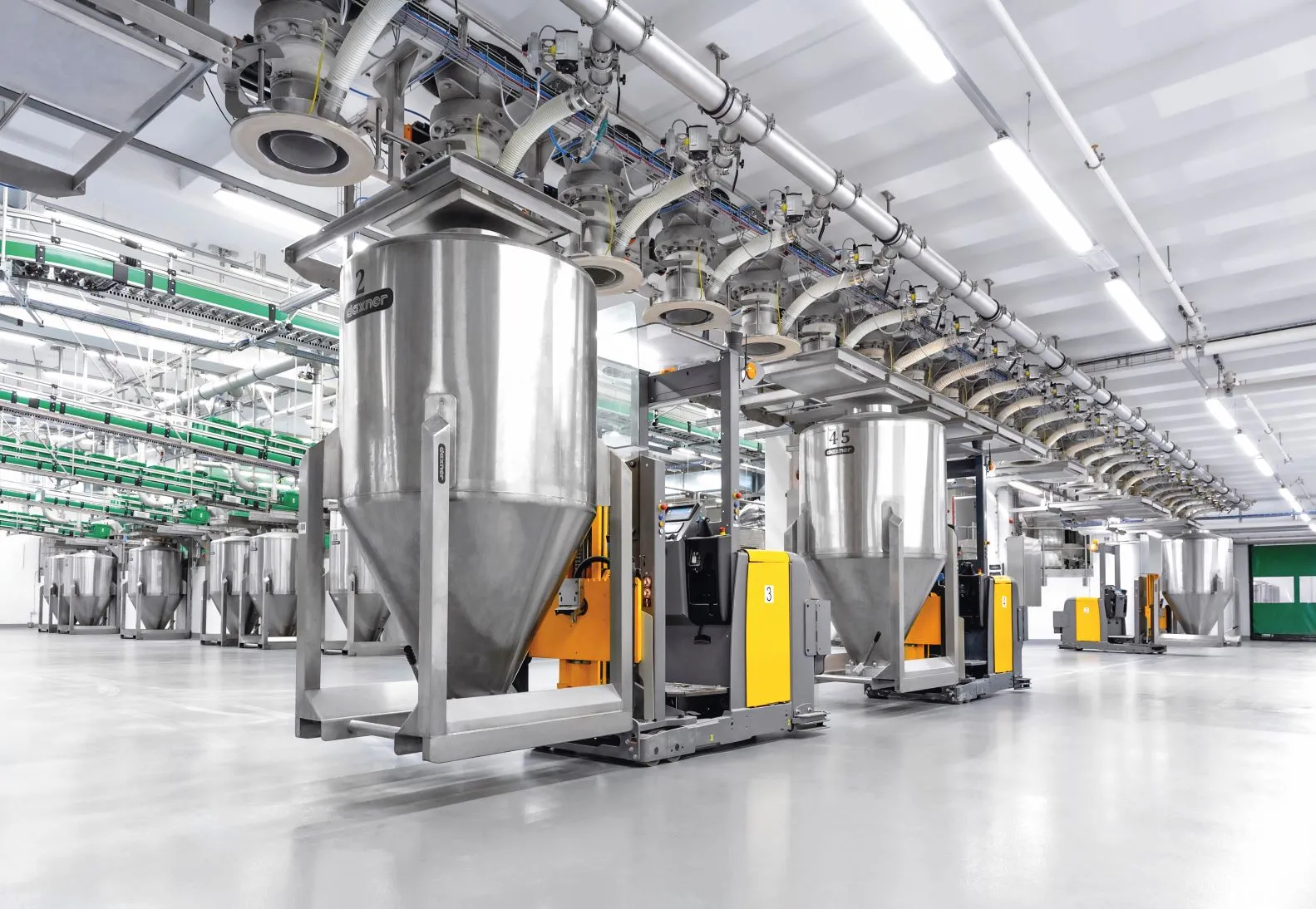
Central raw material conveying systems address this challenge by structurally bundling material supply. Material receipt, preparation, and distribution are consolidated into a higher-level system and centrally controlled. Supervisory control architectures allow modern production control and traceability requirements to be implemented. A key advantage lies in the systematic acquisition and linkage of material data. Granulate type, batch, feeding station, and time can be clearly assigned. In addition, material preparation parameters such as drying, dehumidification, or dedusting can be documented and allocated to the respective processing machine. Via standardized data interfaces - commonly OPC UA in practice - this information can be extended to product level and integrated into existing audit trail or quality assurance systems.
Download the full white paper to learn how early planning of central material conveying systems becomes a decisive factor for efficient, traceable, and future‑proof plastics manufacturing facilities.
.webp)
Other Interesting Articles
Brownfield or Greenfield?
Success Factors for GMP Construction and Qualification Projects

Automation That Pays Off: Finding the Right Balance Between the Man and the Machine
More Flexibility, More Capacity, Ready for What’s Next
Strategic Planning for Bakeries and Confectioneries: The Path to a Master Plan

Pharmaceutical Logistics: More Safety, Speed and Efficiency Through Holistic Planning

Management of Hazardous Substances in Warehouses: Four Areas of Requirement for Industrial Construction
The Food Factory of the Future: Master Plan for a Future-Proof Food Production

Smart Proteins, Smart Factory: Efficient Production for Alternative Proteins
Automated Guided Vehicles: How to Create a Vendor‑Neutral Specification Sheet
The Bakery of the Future: 4 Success Factors for Sustainable Bakery Production